Showing posts with label Guest Blogger on Dishin' It Out. Show all posts

Thursday, June 30, 2016

Charlene Raddon asks about Button


The button—with its self-contained roundness and infinite variability—has a quiet perfection to it. Running a cascade of buttons through your fingers feels satisfyingly heavy, like coins or candy; their clicking whoosh and blur of colors lull you. A button packs an extraordinary amount of information about a given time and place—its provenance—onto a crowded little canvas. Children learn to button and unbutton early in life, and they keep doing it until they’re dead.

The earliest known button, according Ian McNeil in An Encyclopedia of the History of Technology,"was originally used more as an ornament than as a fastening, the earliest known being found at Mohenjo-daro in the Indus Valley [now Pakistan]. It is made of a curved shell and about 5000 years old." Early buttons like these usually consisted of a decorative flat face that fit into a loop. (Reinforced buttonholes weren’t invented until the mid-13th century). Percent% Buttons in this period almost never appeared in straight rows, but were used singly as sartorial flourishes.

Along with brooches, buckles, and straight pins, buttons were used in ancient Rome as decorative closures for flowing garments. However, none of these options worked perfectly. Pins poked unsightly holes into precious fabrics. Supporting yards of cloth at a single point required buttons of architectural heft, made of bone, horn, bronze or wood. Some designs took the functional pressure off buttons by knotting the fabric securely into position, then topping off the look with a purely ornamental button.

(Incidentally, as a button alternative, Mycenaeans of the Roman era invented the fibula, a surprisingly modern forerunner to our safety pin. This design was lost with them until it re-emerged in mid-19th century America.)
The button became more prominent among the wealthy in the Middle Ages.  “About the middle of the eleventh century,” writes Carl Köhler in A History of Costume, “clothes began to be made so close-fitting that they followed the lines of the body from shoulders to hips like a glove.” Buttons helped that snug fit along. This didn’t mean clothes were cut more sparingly; wealthy people still liked the costly display of excess fabric. But, on both men’s clothes and women’s, buttons helped accentuate lovely lines, of the arm, say, or the bosom.
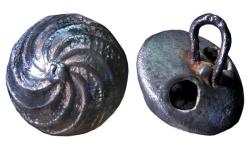
Spanish metal button dating from about 1650 to 1675.
Courtesy Button Country.


The first button-makers guild formed in France in 1250. Still regarded as less-than-functional jewelry, buttons were so prized that sumptuary laws restricted their use. Books, Banks, Buttons and Other Inventions from the Middle Ages by Chiara Frugoni relates how, in a period tale, a magistrate quizzed a woman overly bedecked in buttons.
Buttons came in all shapes and sizes, but most often they were mounted on a shank; you ran thread through the shank’s hole to attach the button to fabric. Unlike modern buttons with their iconic four-square holes, the shank style left the button’s face totally free: a tiny blank canvas one could cover, carve, polish, or paint with luxurious abandon.

The medieval period was the era when wearing lots of buttons meant big money. Franco Jacassi, reputedly the world’s biggest button-collector, describes this as a time when you could pay off a debt by plucking a precious button from your suit. Italians still describe the rooms where powerful leaders meet as stanze dei bottoni, “rooms of the buttons.”

On women’s clothes particularly, buttons traced the body’s lines in suggestive ways, making clothes tight in all the right places or offering up intriguing points of entry. Along with ribbons, laces or bows, buttons were often used on detachable sleeves, a fad that ran from the 13th to 15th centuries. These sleeves could be easily swapped between outfits and laundered whenever they got dirty. Courtiers might accept an unbuttoned sleeve from a lady as a love token, or wave sleeves in jubilation at a jousting tourney.
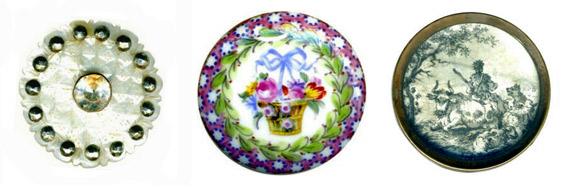
18th Century buttons.
18th century buttons, courtesy Button Country
After the Renaissance in Europe, buttons—along with many other things—became increasingly baroque, then rococo. Among the more extreme examples were “habitat” buttons, built to contain keepsakes like dried flowers, hair cuttings or tiny insects under glass. Hollowed-out smuggler buttons allowed thieves to transport jewels and other booty secretly. (This tradition of buttons-for-crime resurfaced in a heroin-smuggling attempt in 2009.)     

Ornate buttoning among the wealthy required some help. Around this era is when buttons migrated to different sides of a shirt for men and women. Men usually donned their own shirts, so their buttons faced right for their convenience. Women with ladies’ maids wore their buttons on the left, to make it easier for the maids to maneuver while facing them.

George Washington’s 1789 inauguration gave the world its first political button. Made of copper, brass or Sheffield plate, these buttons could close a pair of breeches or a jacket while simultaneously announcing the wearer’s politics. Political buttons took on a more recognizably modern (and less functional) shape during Lincoln’s 1864 re-election campaign. (View 150 years of political buttons here.)
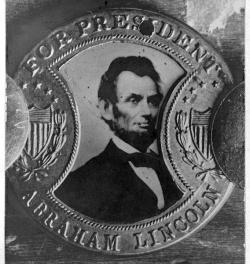
Campaign button for Abraham Lincoln, 1864.
A Campaign button for Abraham Lincoln
Poorer folks wore buttons, too, but they had to craft them laboriously by hand. In Colonial America until the early 20thcentury, working-class families counted themselves lucky if they owned a hand-held button-mold. You heated up the mold in a bed of hot coals, then filled it with molten lead or pewter, which set into a button shape. The sturdy metal buttons could then be covered with fabric or other embellishments.

Extra buttons made at home could also be sold, which meant button-making could be hellish piecework. Playwright Henrik Ibsen channeled his own awful memories of home button-molding in a pivotal scene in Peer Gynt. Sent to fetch Gynt’s soul, the Button-Moulder explains how the very good and very bad go to heaven and hell, but the middling-good are “merged in the mass” and poured into purgatory, an undifferentiated molten stream from the Button-Moulder’s ladle.

Button-making was mercifully accelerated with the Industrial Revolution. An 1852 article from Household Words, a journal edited by Charles Dickens, marvels at the latter-day miracle that was automated button-manufacturing. The writer describes how engravers cut steel dies into the latest fashionable shape, while women and children stamped out pasteboard and cloth to cover the buttons by machine. Another machine stamped out the four holes that had become prevalent for men’s dress-shirt buttons, while another was used to “counter-sink” the button, pressing its center to form a raised outer ridge. (It’s this four-hole flat button that we regard as its iconic shape today.)

A rash of button patents during this period protected nearly every aspect of button-making, from manufacturing methods for glass or mother-of-pearl buttons, cheaper wire buttons, even improvements to button display cards for sale.
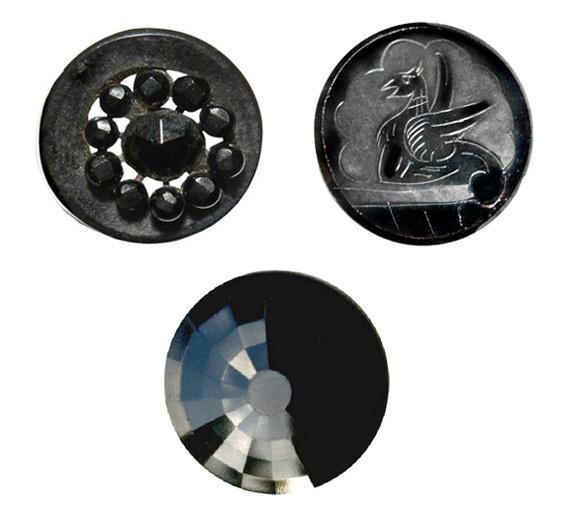
Black glass buttons.
Black glass buttons courtesy Button Country
With the growing number of actual buttons came a parallel growth in button metaphors in everyday speech. The OED lists several, dating from the late 1800s to the early 20th century: “to take by the buttons” is to detain someone in conversation; “dash my buttons!” is an epithet of surprised vexation; “to have a soul above buttons” indicated someone employed in a profession unworthy of them; those who “have all their buttons” enjoy sound intellect, while those who are “a button short” do not.


This grand democratization didn’t stem the tide of expensive ornamental buttons. Victorian “Tussie-Mussie” buttons pictured tiny bouquets whose flowers held symbolic messages. Queen Victoria donned mourning buttons of carved black jet upon her husband Albert’s death, kicking off a fashion among bereaved button-wearers throughout the Empire.

Once they became cheap enough to produce en masse, buttons by the hundreds lined most kinds of tight-fitting clothing, including shoes. (More buttons, closely spaced, gave the wearer the tightest fit.) In his book The Evolution of Useful Things, Henry Petroski explains how this profusion of buttons gave rise to a parallel problem: “Fingers were not a very effective tool for coaxing the crowded buttons through small buttonholes.”
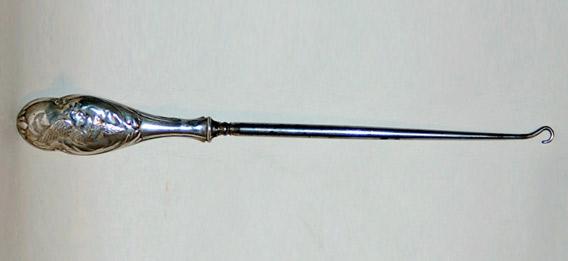
An early 20th century art nouveau steel button hook with a sterling silver handle.
Early 20th century button hook

The solution? Buttonhooks, long crochethook-like devices used to draw buttons through holes rapidly. These evolved into various styles to accommodate different button sizes.

Tracing the body’s curves with increasing exactness, buttons have long equaled body consciousness. In the 20th century, button’s sexier  side came more overtly to the fore. Buttons, in other words, designate sites of vitality, embarrassment, and thrill. When told that a certain lady wouldn’t hurt a fly, Dorothy Parker retorted, “Not if it was buttoned up.” Gertrude Stein’s slim volume Tender Buttons (1914) is winkingly named after the clitoris. Electrical devices, newly introduced, often used flat-faced “buttons” to complete a circuit, giving rise to double entrendre phrases like “press all my buttons."
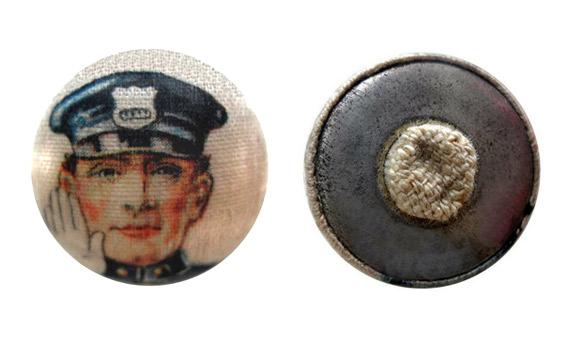
A fabric-printed garter button, used by flappers to hold up their newly-visible stockings.
Fabric-printed garter button used by flappers


Later in the century, buttons migrated as a metaphor from the mechanical world to the virtual one. Buttons now adorn screens big and small, promising to connect us to marvels with a single click. Steve Jobs said of the buttons on Apple’s touchscreens, “We made [them] look so good you'll want to lick them.”
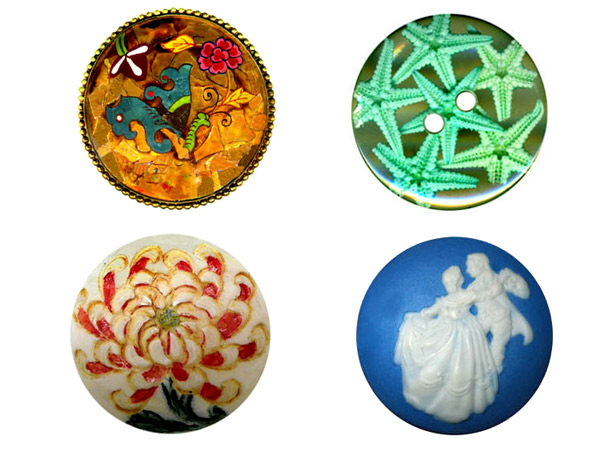
images%2Fslides%2FMisc
Even though zippers entered the clothing-closure scene around the turn of the century, we still wear buttons today. Why? Reasons abound: Zippers can jam and warp or catch little children’s fingers. Velcro, another new-fangled closure, is too futuristic to be taken seriously. Hook-and-eyes and laces have their adherents, but their ubiquity is nowhere near that of the button.

Buttons, in short, offer everyday pleasures. Their little faces turn up agreeably, asking for personality to be impressed upon them. Buttoning oneself up is a slower, contemplative act; unbuttoning someone else, deliciously more so. Pressing buttons still delivers everything we love in the world to us. Why would we ever phase that out?


Charlene Raddon is a multi-published author of historical romance novels set in the American West. She is also a graphics designer.

http://charleneraddon.com
http://charleneraddon.blogspot.com
http://silversagebookcovers.com

Tuesday, June 28, 2016

Naked and Afraid

www.laurirobinson.blogspot.com


When I first heard about the show a couple of years ago, my first impression was along the lines of you’ve got to be kidding. Now, I have to admit, I end my weekend by watching the latest episode on Sunday night. I am amazed by the courage of these people. They agree to strip themselves of everything except their knowledge in order to survive in a strange and often hostile environment, with a person they’ve never met.  

These people have to forge out food and shelter, and some come up with very creative ways to make clothing or cover themselves. They also have to learn how to get along, negotiate, learn new skills, and depend upon each other. At times personalities clash, ideas fail, and accidents happen. 

Within the short span of an hour, including commercials, I find myself liking people I didn’t think I would have during the opening scenes, saddened by some I’d thought would succeed and didn’t, and rooting for a successful extraction for those who have forged their way through twenty-one days. 

In many ways, this is the closest I’ll ever be to watching anything close to the nitty-gritty of the American pioneers who sold everything, packed up and headed for the Wild West. Though many traveled in groups and/or with wagon trains, and they weren’t naked, I can imagine many of the pioneers were afraid. They had brought along a few basic necessities, but ultimately, when they eventually arrived at their destination, which was often a chunk of virgin land, they had little but their knowledge and skill to survive the fast approaching winter. It couldn’t have been easy, and they certainly didn’t have a camera crew they could appeal to for medical help or a ride home when the going got too rough. The raw basics of human nature had to be the same. The will to survive. The determination. The joy of successes and the heart-wrenching disappointment of failure. 

There’s my confession, or maybe it’s my justification for watching a show I first scoffed at. Either way, I watch Naked and Afraid, and will continue to. 

My next release will be June 1st. The heroine in Her Cheyenne Warrior is close to being naked and most certainly afraid when Black Horse scoops her out of the middle of the river in Wyoming.

The Cheyenne's captive! 
Runaway heiress Lorna Bradford must reach California to claim her fortune, but when she's rescued from robbers by fierce warrior Black Horse, she's forced to remain under his protection. 
Immersed in a world so different from her own, wildcat Lorna learns how to be the kind of strong woman Black Horse needs. But, to stay by his side, she must first let go of everything she knows and decide to seize this chance for happiness with her Cheyenne warrior!

Robinson’s talent for period detail shines in her newest stand-alone novel, and the author’s dare to go retro with the classic “Englishwoman vs. Indian chief” plot might just revive an entire sub-genre. Mildly sexy and thoroughly engaging, this tale of broken hearts allowing love in once more is a guaranteed HEA. RT REVIEWS- See more at: http://www.rtbookreviews.com/book-review/her-cheyenne-warrior#sthash.uBAdv9Wf.dpuf


Thursday, February 14, 2013

DIANE SCOTT LEWIS IS VISITING TODAY!

 
A Novelist’s Lament: How do I Find Time to Write with a Recently Retired Husband?

My husband retired a month ago—who can resist twice the time on half the pay?—and we moved three states away to be closer to our grandchildren. Before his retirement I spent every morning at my computer, checking email, blog posts and revising my novels. The house was quiet and conducive to creativity. I would sip my coffee and immerse myself in the eighteenth century to construct my historical novels.

Now, you may ask, is it still so quiet?

Every morning now I have company. My husband watches the Today show and often calls me into the living room to “see” something. If I don’t go, he talks about it from that room (which is very close in our downsized house) so I can visualize it. I tell him I need to finish what I’m doing, but this lands on deaf ears.

The man who owned this house before us—also retired—fell down the garage steps and died. I “visualize” his wife pushing him down the stairs because he talked too much. (I say this very tongue-in-cheek, of course...I think.)

My husband starts a project and hammering or sawing may commence—and I’m grateful he’s occupying himself. However, the dog begins to bark like a banshee while I’m trying to research how an eighteenth century woman might prepare a cordial. Yikes, hands over ears!

I started revising a new novel and was up to page 93. One month later, I’m still on page 93, but I do know all about how my hubby arranged his tools in the garage.

He just came in to tell me the finer points of why the TV upstairs is “in his control” because he’s taping two shows downstairs (in the Man Cave I wish he’d spend more time in) and with the Hopper, he can’t watch anything with two shows taping... I refrain from explaining that I wasn’t watching the upstairs TV, I was posting on Twitter and Facebook about my recently released novel being free today.

And now that he doesn’t have to get up at the crack of dawn to commute to his job, he’s so frisky and amorous...a situation which involves me when I’m encouraging him to find his own hobbies and interests that don’t involve me. I try to dress like a frump to deter him, but nothing discourages him when he’s enjoying so much time to canoodle with me!

Needless to say, we need our boundaries and he doesn’t yet understand that just because he is “free as a bird” I still have my writing obligations and my passion is telling stories.
I do appreciate him, his cooking every night, his going to the grocery store. But how do I get back my Office Hours?

I guess I’ll have to sneak into the garage and hide his tools in various places so he has to keep arranging them, and hopefully not tell me every little detail about it.

To find out more about me and my books, and see a picture of my husband, visit my website:

Tuesday, February 12, 2013

Welcome Sydell Voeller Back with Her Sister's Keeper

Logan Corbett, registered nurse, suddenly becomes the guardian of her 10-year-old sister, Kim. A former prizewinning gymnast, the girl was seriously injured in the same plane accident that killed their parents. Logan admits she's overly protective of Kim, but only wants what she thinks is best for her. Dr. Zachary Dellinger, a pediatrician at the hospital where Logan works, suggests that Kim should attend a summer camp for children with special needs. Logan agrees, but on one condition--that she will volunteer to be the camp nurse so she can keep a close eye on Kim.

 Under starlit skies and breezy summer days, Logan struggles with her growing attraction to the handsome pediatrician--all the while, battling the urge to hold on too tightly to Kim. Will Logan ever be able to let go enough to allow love into both their lives?


"Her Sister's Keeper is a wonderful story of sisterly love and devotion. Delightfully written characters are a key part of this believable and enticing tale...a highly recommended read for contemporary romance readers..."
-Penny, Fallen Angel Reviews

A wonderful tale of the ability not only of the adult, but definitely for the children to survive life's foibles. You will gain a better understand of overcoming adversities whether you are young or old.
--Rendezvous Magazine

Buy Link:  http://www.amazon.com/Her-Sisters-Keeper-ebook/dp/B007ULHBXQ

Sunday, March 4, 2012

Welcome, Gabrielle Bissett to DIO


When I first began writing my current release, Blood Avenged, I knew I wanted the book to be the first in a series.  The idea of a group of vampires, the Sons of Navarus, sworn to protect the vampire world and the most ancient members of it appealed to me.  What also appealed to me was having the chance to write a variety of heroes. 

The first hero, Vasilije in Blood Avenged, is every ounce a hedonist.  He loves physical pleasure and seeks it out at every turn.  Over four hundred years as a vampire, he's a very sensual character who has seen so much of the world, so writing him was a delight.  Almost everything he says and does in the story is so thoroughly based in his desire for pleasure. 

Here's the blurb for Blood Avenged for a little taste of Vasilije:

I am everything you desire.  I am vampire.
Powerful and manipulative, Vasilije does as he pleases. A vampire beholden to no one, he takes what he desires, drinking deeply the pleasures this life has to offer.

When one of his own is staked, Vasilije must travel to New Orleans to exact his revenge. There he meets Sasa, a beautiful woman who arouses him like no other has for centuries. Vasilije’s need for vengeance is equaled only by his passion for her, but what he finds in his revenge is just the beginning...

Even the book's cover conveys his pure hedonism. 

And then there's the hero of the second book, Blood Betrayed.  Saint is a very different kind of character.  A far younger vampire, he was turned on the battlefield during the First World War.  Saint is a hero haunted by his past, so he's got some demons to deal with, especially concerning the heroine of the story, Solenne. Because of this, he's darker and more brooding than Vasilije ever could be.  He's also a criminal in the vampire world because he refuses to sleep with anyone but human women.

Here's the blurb for Blood Betrayed for a little sampling of Saint:

I am everything forbidden.  I am vampire.

Haunted by betrayal, Saint hides in the human world, giving his heart to no one and finding the only solace from his past in the arms of human women. Now as the Archons begin their takeover of the vampire world, this Son of Navarus has been marked for death. 

Summoned to defeat the Archons by the world that shunned him, Saint must face his past and Solenne, the woman he loved and lost a century ago, for only in accepting her will his body and soul finally find salvation.

And the cover of his book reflects his haunted nature.

Writing a series is great fun in many ways, but the ability to choose what kind of heroes will be showcased is one of the most enjoyable.  There are eight vampire heroes in the Sons of Navarus, so I'll have the chance to write six more after Vasilije and Saint.  I can't wait! 

Readers can find out more about Blood Avenged, Blood Betrayed, and the upcoming books in the Sons of Navarus series by visiting my blog at http://gbisset.blogspot.com/p/sons-of-navarus-series.html

In addition, readers can find me at these places too!

Website:  Gabrielle Bisset
Blog:  Gabrielle Bisset: A Writer's Blog

Facebook
Twitter
Amazon Author Page
Email:  gabriellebisset@gmail.com

Thanks Ginger for having me here at your blog today!  It was a pleasure.

Romance Reviews

The Romance Reviews