Showing posts with label Connie Vines. Show all posts

Monday, March 15, 2021

Happy (almost) St. Patrick's Day! By Connie Vines

"The first recorded St. Patrick's Day parade was held not in Ireland but in New York City in 1762, and with the dramatic increase of Irish immigrants to the United States in the mid-19th century, the March 17th celebration became widespread."


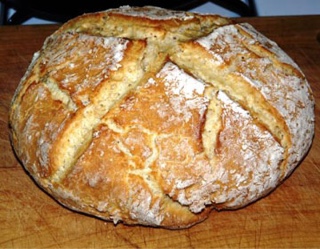
Since everyone visiting ' Dishin' it Out' today, has general knowledge of the celebration, I thought I'd share my often baked soda bread recipe.  I serve the bread warm and search slice is smeared with Irish butter and a dollop of orange marmalade.

3 1/2 cups all-purpose flour
2 Tablespoons caraway seeds
1teaspoon baking soda
1teaspoon salt
1 1/2 cups buttermilk

Directions:

1.Preheat oven to 450 degrees Fahrenheit
2. Mix flour, caraway seeds, baking soda, and salt in a large bowl.
3. Mix buttermilk and stir until large minister clumps form.
4. Gather dough into a large ball and lightly flour outside.  Place dough into a ball and kneed until dough becomes smooth and hold a together.
5. Roll into a large ball and lightly flour the outside.  
6.Place the dough ball in a non-stick baking sheet and shape into a 6-inch diameter ny 2-inch tall mound.
7.Cut a 1-inch deep X across the top, extending the edges.
8. Bake approximately 35 minutes, until bread is golden brown and sounds hollow when tapped on the bottom.
9.Remove from the baking sheet and allow to cool completely.
10.Cut into 8 wedges.

This is sooo easy and sooo delish!


Saturday, June 22, 2019

Life Events in My Stories—Here’s the Real Scoop! By Connie Vines


This Month’s Topic: Has an event in your life, or that of someone you know, or one covered in the news ever worked its way into one of your stories?
I believe we are all influenced by our environment and, being social creatures, we are also empathetic to the people we encounter in life.


Each of my novels, short-stories, and blog posts touch on an event in my life, a factual experience in someone’s life.

When I was writing for children’s magazines my topics included historical events or modern-day mysteries.  My YA historical novel, Tanayia-Whisper upon the Water, has excerpts from newspapers of the 1800's for chapter intros. I experienced the wind and the sadness which still surrounds Wounded Knee, I’ve dance at Powwows, and made fry-bread for hungry children. 

Having been interview (unexpectedly) by a news crew, I know the irritation you feel when someone shoved a mic in your face (Lynx’s interview scene in Lynx, Rodeo Romance).  

I believe the true test of a writer is researching a subject and making the event seem real to the reader that he/she can ‘live the story’.  Obviously, writers have never been a 16th century pirate, or a vampire, however, these stories are written and are believable.  Non-fiction worlds are created, we mourn the death of our beloved fictional characters, we fall in love with a hero or two.  

Since I grew up in a military family, relocation was a way of life.  My characters are seldom stay-forever-in-one town people. I am able to share the force of a hurricane, a tornado forming on the plains, sea-salt and sand in your clam-bake meal, the smell of a swamp, and fragrance of cafĂ© au latte on a cool May morning in the French Quarter of New Orleans, Louisiana.

**  
From Tanayia—Whisper upon the Water:

My gaze narrowed. Each day I watched Anna Thunder hide her slice of bread in her skirt pocket. I did not why. Each night I watched.  She did not bring the food from her pockets, nor were there crumbs leaving a trail among her belongings. 

“Why? Why do you ask this?”

The Comanche was thin. Her arms were like the bare branches of a sapling tree. Anna Thunder did not eat the bread she hoarded.

“Will Apache bring bread?” she hissed.

My stomach growled. Sister Enid had returned last evening and supervised the breakfast meal today. The oatmeal had been thin. There was little nourishment for my growing body. The bread Sister Kathleen gave me kept the pains of hunger from my stomach. I did not want to give my food to my enemy.

**
Please visit the blog sites of these wonderful writers and read the stories she/he have in store for you!

Happy Reading!

Connie


BUY LINKS


Friday, February 1, 2019

Introducing Romance Gems by Connie Vines

On February 1, 2019, Friday, 23 popular authors including NY Times and USA Today bestselling authors, open the doors on ROMANCE GEMS, a wonderful new group blog where the focus is on Readers. Look for conversations about Life, Love, Books, Romance, Sex, Kids, and all the other really important things in your world. Some chuckles and some good times await you so drop by and check out ROMANCE GEMS at http://RomanceGems.blogspot.com.

Be sure and enter the Rafflecopter (A Chance to Win Books, Kindle Fire, and ebook Gift Bundles/) for a Kindle Fire and ebook Gift Bundles. Every week, there will be a "Comment & Win" Random Draw for an Amazon Gift Card. Read and comment with your email address written out on the daily posts. The more comments you make; the greater your chance of winning. Enter the Rafflecopter and the "Comment & Win" Random Draw as often as you wish. The more you enter, the greater your chances of winning.

If you've been looking for a Gem of an Author and/or a Gem of a Romance, look no further. You'll find both at ROMANCE GEMS.


Saturday, August 26, 2017

Pets and Other Animals in a Story by Connie Vines

Today's Topic: Have you used pets or other animals in your stories? What function do they perform in the story? Do they need to have a function? Can they be a character?

Since I am an animal lover and owner of a multitude of pets (exotic, barnyard, and typical suburban) at various times during my life, it only goes to reason that I will have them peppering my short stories, novellas, and novels.  My Rodeo Romance Series (understandably) incorporates a cast of horses, sheep, cattle, dogs, cats, etc.  Some of these animals only have Cameo roles, while others are characters in their own right.

 My Fun & Sassy Fantasy Series also features a pet as a main character in each story line.  Gertie, a pet Teddy-Bear Hamster, is Zombie Meredith’s BF is “Here Today, Zombie Tomorrow”.  “Brede” Rodeo Romance, Book 2 features a horse and cattle dog.  “Lynx” Rodeo Romance, Book 1, features the hero’s horse named Texas. The next book in my series, “Rand” Rodeo Romance, Book 3 features a poodle who belongs to the heroine.  Rand’s interaction with this very unrodeo-like dog is priceless!

For realistic purposes I select animals/breeds that I either have owned, or have working personal knowledge (chickens, turkeys, quail, pheasant, pigs, sheep— bred for. . .well, dinner during my rural days).  My dogs: Greyhound (my favorite & a rescue) Poodle (AKC champion pedigree), Shepherds, Collie, Weimaraner and– my husband’s dog, a Chi-wienie (Chihuahua Dachshund mix). I also like to add my horses (Quarter horse, Arabian, and a Paint –a retired rodeo barrel racer) into the mix.  Due to my allergies to cats, my info comes mostly via friends and the Animal Channel.  Now the unconventional pet experiences, were learned firsthand (I did raise sons and have 3 younger brothers).  Pet mice, geckos, iguanas, horned toads & lizards, hamsters, parakeets, an Amazon parrot, finches, a runaway cockatiel, and canary have a way of finding a place in my life and my stories.
Future adventure with pets?  Probably.

I simply adore baby pygmy goats.  Mind you, I reside in the quirky suburbs of Southern California.  Therefore, my husband reminds me, often. “You cannot raise a goat in our backyard, there are zoning laws.”

Of course I know there are zoning laws.  I also know goats are herd animals.  “We will need to have two goats,” I say him.

“We?” He grunts and goes to his ‘man-cave’.

I watched a YouTube video and read an online article titled: Pigmy Goats.  With the opening hook: You should reconsider your choice in pets if you want an animal to stay indoors with you.

One fact was of particular interest, and brought back memories of living in an all-male household: ‘Goats are messy eaters too, pulling feed out of buckets and leaving it on the floor.  Once it’s trampled, they really don’t want to touch it.’

Ummm.  Obviously, I am not alone in my secret desire to own one of those adorable little goats.  However, since have zero desire to relocate or have two goats head-butting or chewing my maple dinning room set or my wood flooring, I guess I’ll settle for a petting zoo outing with my three-year old grandson.

While my characters do not always have pet, my characters have often had a pet during childhood, interact with an animal, or (YA stories) would like a pet.

Why, do I believe animals are important to a story line?

It is a way to show character, good and bad.

How people treat animals will give a reader insight into my main character, or my villain.  Treatment of animal hints at how he/she will treat a vulnerable person (child/spouse).  If the hero seems uncaring and selfish to outsiders, give the heroine a view into an unguarded moment he shares with an injured puppy, or his care of his horse.  His truck may be battered and dirty, but his horse is well groomed, fed, and sheltered each night.

However, my animals need to have a purpose.  Sometimes it may only be comic relief, or a confidant in a YA novel, but unless it is a Cameo role (or red herring), my animals have a personality and a place in the storyline.

Who doesn’t remember, “Call of the Wild”, “Old Yeller”, “Misty of Chincoteague”?

I believe pets, can enrich a story—my novels, as are (in my opinion) most genre novels, are about life and the human need for love and companionship.

Not every novel calls for an animal to part of the story.

Not every person wishes to be responsible for a pet.

I did a bit of research and discovered these stats (the info about fish surprised me).
*Stats: 2014, 83.2 million dogs live in U.S. households, 95.5 million freshwater fish live in U.S. household, and 85.8 million cats live in U.S. households.
* Statista.com

So, what do you think?  How do you feel?

As a reader, do you enjoy pets in a storyline?  Do you look for authors who have a series you know will feature a heroine with a pet(s)?

Please add a comment with your opinion beneath this blog article.

Happy Reading,
Connie


Saturday, October 8, 2016

What is a Writer's Natural Temperament? by Connie Vines

What is a writer’s ‘natural’ temperament? 


An image  of a novelist as a melancholy, moody artists who dons black as penning books during fits of insomnia or alcoholic inspiration pervades much of our society’s view of writers. No doubt some writers are like this, and the fact that some of the most famous were – the existentialists and the beat writers typically wore black while Hemingway drank continuously – has no doubt contributed to the stereotype that writers are restless and unhappy. 

Unfortunately, this also has led many budding novelists to believe that they can’t be successful unless in a state of “discontent.” 

If there is an overarching temperament that is important to all fiction writers, curiosity about life and others arguably is paramount. Should that curiosity lead to discontent and anxiousness, then the author can write the kind of stuff of that discontented writers like to read. Hopefully that curiosity instead leads to a sense of self-improvement and love of craft so that one can master – or even influence – the genre that you write in.

I have found the best writers aren’t necessarily the smartest, the smoothest, or those with the biggest vocabulary. The best writers are those that possess an unforgettable personality.

A writing personality is just as real, unique, and nuanced as your personality in everyday life -- except you only release it when you create content. And if you can create content that brims with personality, I guarantee that people will love reading it. They’ll come back to it again and again. They will share it.

Your personality becomes your authentic signature, a trademark that appeals to your target audience. Not to mention, it'll serve as a source of incredible brand power and potential. 

1) Embrace your (writing) personality.

The problem with a writing personality is that most people don’t realize that they should have one. Instead, they try to follow the rules and regulations handed down to them by a well-meaning 10th-grade composition teacher. Or, if they do realize the importance of a writing personality, they try to mimic someone else’s personality.

You have to discover and shape your own personality in your writing. It takes time and effort, but it’s possible. Each of these tips will help you do just that.

2) Pick a focus and stick to it.

To have a consistent writing personality, you need to start by having a consistent area of focus. This can be something broad like marketing or more specific like social media. The important thing is that you're not all over the place. 

Food blogger Ree Drummond is a great example of a writer who has a clear topic. She could write about anything and do a darn good job, however, she uses her writing personality to focus on one topic, and one topic only.

 Break grammar rules.

Some people are inveterate rule breakers. And that’s okay. While we don't recommend you throw grammar out the window, breaking a rule every once and a while can serve as a great way to amp up your personality.

What kind of grammar rules should you break? It depends. Here are some common ones:

Sentence fragments: “Seriously. I mean, people, really.”
Punctuation: “I. Just. Can’t. Even.”
Starting sentences with conjunctions: “But I’m okay with that.”
Using “like”: “It’s not like you’ve sinned.”
Using a preposition at the end of a sentence: “You’ve got to get your traffic up!”
Again, be careful with rule-breaking. If you’re frivolous with your grammar, people may start to suspect your intelligence rather than respect your personality.

Get to know your audience better.

The principal group of people who should shape your personality is your audience.

Why? Because they are the ones consuming, accessing, and subscribing to it. Make sure that your personality does not cross their boundaries of proprietary, offend their sensibilities, or rub them the wrong way.

5) Highlight a personality trait that you have in real life.
Your writing personality isn’t exactly the same as your real life personality. Writing and in-person interactions are intrinsically different. However, there is usually some overlap.
If you’re known as a smart and serious individual in person, then your writing can convey that. If people know you as “the funny guy,” then let your humor shine through in your writing.
It’s your personality. Own it.
6) Talk about yourself on your blog posts.
To truly own your personality, you have to talk about yourself. Many successful bloggers and writers aren’t afraid of using “I,” “me,” and “my.” It’s not self-centered. It’s just a natural way of communicating.
7) Write like you talk.
Writing like you talk is generally a good idea. Obviously, you want to cut out useless filler words. “Um” and “uh” aren’t necessary in writing.
At the same time, your style of speech is a mark of your personality. If you’re sarcastic, gentle, incisive, crude, bombastic, or use outrageous expressions, shake a little bit of this into your writing.
8) Stay organized in your blogging and the writing of your novels.
Don’t allow your personality, whatever it is, to throw off your organization.Good writing is inherently organized. If you have a disorganized and scatterbrained  personality in real life, don’t try to import this into your writing. People don’t like to read scattered and disorganized content. Create an outline and stick to it.
10) Write in a way that you enjoy.
When you enjoy the way that you write, you know you’re hitting a personality stride.
11) Be authentic.
12) Commit to your style.
Once you get into the groove of your personality, don’t change it. Your audience expects you to be a certain way, write a certain way, and convey information in a certain way.
Ready to let your personality shine?
You are you, and your writing needs to have your fingerprints, timbre, voice, and personality all over it. Unleashing that personality in your writing starts with knowing it, owning it, and not being afraid to let it loose.
What’s your writing personality? How does this impact your writing?
Please visit the other members of today's Sunday Blog Hop!
Connie


Friday, September 23, 2016

What Eccentric Writing Habits Have I Never Mentioned? By Connie Vines

When you mention that you are a writer, people often take a step back and give you that 'once over' inspection. This reaction used to make me uncomfortable.  Now I only smile.  I don't know exactly what I'm expected to look like--Stephen King, perhaps?  Joan Wilder?  Charlotte Bronte?

When I am asked about my writing methods, schedule, inspiration--I respond truthfully.  However, I never tell people every little thing.

Most authors, of course, have personal eccentric writing practices. Fueled, no doubt by his or her personal muse.  Agatha Christie munched on apples in the bathtub while pondering murder plots, Flannery O’Connor crunched vanilla wafers, and Vladimir Nabokov fueled his “prefatory glow” with molasses.

Then there was the color-coding of the muses:  Alexandre Dumas, for decades, he penned all of his fiction on a particular shade of blue paper, his poetry on yellow, and his articles on pink; on one occasion, while traveling in Europe, he ran out of his precious blue paper and was forced to write on a cream-colored pad, which he was convinced made his fiction suffer. Charles Dickens was partial to blue ink, but not for superstitious reasons — because it dried faster than other colors, it allowed him to pen his fiction and letters without the drudgery of blotting. Virginia Woolf used different-colored inks in her pens — greens, blues, and purples. Purple was her favorite, reserved for letters (including her love letters to Vita Sackville-West, diary entries, and manuscript drafts. Lewis Carroll also preferred purple ink, but for much more pragmatic reasons: During his years teaching mathematics at Oxford, teachers were expected to use purple ink to correct students’ work — a habit that carried over to Carroll’s fiction.

So how do my little eccentric (or never before mentioned) writing practices measure up?  Is my personal muse quirky, dull, or out of control?

Since my quirks are normal for me, I had to think about this for a bit.

I always drink coffee that is part of my current ‘setting’.  When my setting is New Orleans I mail order my coffee from my favorite spot .CafĂ© du Monde.  I have my cup and saucer, and a portable mug when I writing outdoors.   I have a blue coffee pot and matching tin cup when I writing westerns (yes, the coffee is VERY strong and black).  And of course, a Starbucks cup or a Disneyland mug when my novels take place in So.Cal.


My music and my menu planning also is linked to my settings.  All within the range of normal.  Though I have more than my fair share of coffee mugs and cups.

I listen to diction videos on YouTube so that I am not relying on my memory for the sound of a Cajun accent, Texan’s drawl, etc.

I visit areas on Google Earth and Zillow.  Even if I have lived or vacationed there, I may have forgotten an interesting ‘something’ I can insert into dialogue, or find a way to describe a scene.

I talk to myself.  Or not simple little sentences.  I’m talking about a two- way conversation: “Do you think that might work?”  “No.  No one is that stupid!”  “How about. . .”  This is the time my husband walks by to find out who’s on the phone, or if I’m asking him a question.  The dog even pokes her head in to see what’s going on.  I’m thinking this is a bit outside of the ‘normal’ range.

When I write I have to make certain my work space in in perfect order.  I have colored folders/pens/notebooks that match and are exclusive to the story I’m working on at the moment.

I never enroll in an online class when I’m writing—it’s guaranteed writers’ block.  I never talk about my WIP because I mentally clock that as writing time and lose interest in the story before it’s completed.

Whatever story I’m am working on is my favorite.

I survive on 3 hours sleep when I am deep in a story.  I know I drink coffee, but seem to run the story in my mind when I sleep too.

I also pick up the quirks of my heroines.  I have several friends who are in theater and said it’s a bit like ‘method acting’. Fortunately, I’m back to my state of normal a couple of weeks after typing THE END.

I think all of this part of a writer’s voice.  It is what we, as readers, look for in a story.  Hopefully, it is what my readers, enjoy about the novels, short-stories and novellas that I write too.

Visit my Amazon webpage for my book trailers, teasers, and ebooks and paperbacks.

Happy Reading!

Connie

Hop over to the next blog post


Wednesday, September 21, 2016

What Are You Waiting For? Date a Cowboy by Connie Vines

Since many of my romance and historical novels have Western settings, And my hero and heroine, of course, are both single.  I pondered the dating dilemma of modern day cowboys and cowgirls; ranchers and the like.

During a vacation in South Dakota I realized it was often 60 miles from a ranch to any hope of  a place I would even title a 'mini' city.

That has to make for a pretty shallow dating pool.  Yes there is church, social events, and community members.  But that has an 'arranged marriage' feel to it.  I am looking for danger, mystery, and the great unknown for my contemporary romance.  I'm thinking it's something I won't find in a small ranch town. Because let's face it, small towns are big on letting 'bad-boys' hang around and marry the 'women folk'.

I'd didn't want the expected. . .a former black sheep returns home. . .she runs off with the town's bad boy.

Where you are sitting with a cup of coffee, staring into the great unknown, you realize that there is always a television commercial ad for some service.  Is particular evening, sandwiched between an Atkins and Marie Osmond  NutriSystem commercial, was a  Match.com, E-Harmony commercial.

There are numerous other online sites.  Some sites are specialized, some are not- over 50, Christian, with kids, etc.  Is there a site for cowboys and cowgirls, I wondered?

After a few minutes of Internet surfing I discovered there is indeed a site for cowboys and cowgirls. A surprising number of dating sites, in fact.

Here are the website blurbs (mind you this is not an endorsement on my part--only for research purposes.):

Thousands of singles join Western Match every day looking for dates, friendships, long lasting relationships, or marriage. If you are looking to date a cowboy or cowgirl, meet country singles, farmers, or ranchers, this is the dating site for you. Sign up today and see why Western Match is the best cowboy dating site on the net and the real deal since 2002.

This site brags that it's mobile friendly.

Welcome to Cowboy Cowgirl  Come build relationships with people who share your appreciation for the country way of life, so create a profile and start exploring. Online dating has never been easier! Connecting cowboys and cowgirls since 1999.

The one I found the catchiest was: What are you Waiting for?  Date a Cowboy.  

Yep, that one hooked me--ah, I mean my heroine.


Believe it or not there is even a dating site for Rodeo Cowboys!  Where Rodeo Meets Romance.

Unfortunately, there isn't a site to match cowboys with city girls. . . but I won't letting a little thing like that stop me!

Ideas?  Don't be afraid to share them with me :-),

See you on Saturday,
Connie


Thursday, September 8, 2016

Paw Patrol by Connie Vines

I am a little late in posting today.  This is because I'm on PAW Patrol.


My little Chanel, my poodle-mix, was spayed 5 days ago.  She is healing quite nicely, thanks for asking.  However, if you have ever taken care of an ailing child--or puppy, you know I am getting 'disturbed' sleep.

Like most novelists, I also hold a day job (in education field).  

And like a care provider for any recovering puppy, I make 3 to 4 trips during the night to the great outdoors holding a squirming puppy.  A puppy, mind you, that must be leashed and gingerly allowed (without getting her stitches wet/dirty) to walk in the grass of business.  Then take her back to her kennel for a 'nap'.

Fortunately, my husband is able to take care of her during the day.  Why Chanel only makes 4 outside tarps between 7 and 4, I do not understand.  Of course, feeding time takes place during the day, but that doesn't result in sleep deprivation, to staggering around in the dark.

So it is now 8:45, Chanel is in bed, and I am happily sitting with my iPad in my lap writing this blog post and listening to an episode of Moose TV.

Happy Thursday everyone.

I will be back next week,
Connie Vines

Wednesday, August 24, 2016

Mail-Order Brides in the Wild West By Connie Vines

MAIL-ORDER BRIDES in  the Wild West.

We have all watched many a western movie featuring Mail-Order Brides. I also recall a musical
 (Seven Brides for Seven Brothers) on stage before becoming a 1950's movie also.

So how historically accurate were these movies and (Here Come The Brides) television shows?

What was I able to uncover during my research?

The term "mail-order bride," as it applies to a marriage arranged via correspondence between American men and women in the Great Plains in the nineteenth century, is largely a misnomer. Twentieth-century folklore has it that a homesteader could peruse the Sears and Roebuck or Montgomery Ward catalogs and order a wife to be delivered to his dusty doorstep just as easily as he could order a rifle, stove, or stomach cure, but the truth is far more interesting.

 Arranged long-distance marriage existed in the Plains in a range of communities, took a number of forms, and grew out of a variety of social, economic, and cultural phenomena, but never involved the literal sale, purchase, or ownership of women, as the term "mail-order bride" suggests. (Thank goodness!)

Among Plains Indians, sight-unseen marriage was frequently arranged with the help of a middleman and could involve the payment of a "bride price," intended to compensate the woman's family for the impending loss of her labor. But intercultural marriage was rare. In 1854, at a peace conference at Fort Laramie, a prominent Cheyenne chief requested of the U.S. Army the gift of 100 white women as brides, but the army refused. Russian immigrants brought with them the tradition of koopla, whereby marriage brokers were paid a fee to pair men with potential spouses from the Old Country.

 During the peak years of overland migration, hundreds of thousands of white women traveled west, but the majority were already married, and it was thought that "suitable" single women did not go west alone. While many cowboys eschewed marriage for perpetual bachelorhood, homesteaders believed that married men made better farmers.

From the 1830s until the turn of the twentieth century, settlers pined for "that useful and essential article of household furniture–a wife." So severe was the shortage of single white women of marriageable age in Nebraska, recounts Mari Sandoz in Old Jules (1935), her classic portrait of Plains homesteading, "a man had to marry anything that got off the train."

By 1865 it was estimated that there were as many as 30,000 single women back east, a number augmented by the Civil War widows. The plenitude of bachelors in the Plains–and hence the chance for greater social and economic freedom away from home–beckoned women. Newspapers from Nebraska to Kansas and Wyoming (a state the Ladies Home Journal in 1899 declared a heaven for spinsters and widows) began to serve as forums for matchmaking, running regular "matrimonial columns" of paid advertisements, frequently with accompanying photographs, for example: "A young lady residing in one of the small towns in Central New York is desirous of opening a correspondence with some young man in the West, with a view to a matrimonial engagement. . . . she is about 24 years of age, possesses a good moral character . . . is tolerably well-educated, and thoroughly versed in the mysteries of housekeeping"; or more commonly, "A Bachelor of 40, good appearance and substantial means, wants a wife. She must be under 30, amiable, and musical." Across the Plains there arose a cottage industry of "heart and hand" catalogs, folded double sheets and broadsides devoted entirely to the matrimonial prospects.

Letters were the only means of courtship between potential mates separated by thousands of miles. According to one bride, the Pony Express "took about four weeks to go from east to west," and letters "often came in bundles." Language was a means of persuasion. Illiterate men could dictate their letters to typists who, for a fee, would doctor their sentiments on Remington Standards. Dishonesty was a risk. Men and women could easily misrepresent their physical attributes, their station, or finances. A homesteader who sent his betrothed a train ticket might find that she had turned it in for cash. A 1911 Wahpeton Times article tells of a New York girl for whom, upon arrival in Buford, North Dakota, "the spell was immediately broken" when she saw the face of her intended. ((Not unlike the social media matches of today's cyber world of romance.)


The railroad also played an important role in the western diaspora of single women. In 1882 businessman Fred Harvey sought young rural women "of good character, attractive and intelligent" as waitresses in whistlestop cafés along the Santa Fe rail line. Harvey required that they remain single for a year, live in chaperoned dormitories, and entertain callers in "courting parlors." By the turn of the century, he had married off nearly 5,000 so-called Harvey Girls.

In the 1870s, 80s and 90’S, Matrimonial News, a San Francisco based matchmaking newspaper helped to make love connections between the single men of the West and the statistically disadvantaged, single women back East. For $1.50 a word, people could place classified ads describing themselves and what they wanted in a potential mate. The paper’s goal was to “promote honorable matrimonial engagements and true conjugal felicities for amiable men and women.” If a match resulted in a wedding, both parties were required to pay an additional fee to the newspaper.


Most ads were fairly direct. I haven’t seen a single ad that mentioned enjoying long walks on the beach, but plenty of them were quite open about wanting someone who wasn’t ugly and had a specified amount of money. (At $1.50 a word, it’s a wonder that some ads didn’t read, “Me want woman!”) Interested parties would correspond with each other and often not meet until they were about to head to the altar. It was quite the leap of faith.


I have a feeling "Seven Brides for Seven Brothers" was not historically accurate--though a great deal of fun!

What would drive a woman to accept such a proposal?  What recourse did she have if she changed her mind?

If you have any 'family stores', please share in the comments section of this blog.

Happy Reading,
Connie

Link to Amazon.com !


For additional information:
Luchetti, Cathy. "I Do!": Courtship, Love, and Marriage on the American Frontier: A Glimpse at America's Romantic Past through Photographs, Diaries, and Journals, 1715–1915. New York: Crown Trade Paperbacks, 1996.
Riley, Glenda. Building and Breaking Families in the American West. Albuquerque: University of New Mexico Press, 1996.

Wednesday, July 27, 2016

Dear Diary by Connie Vines

UPDATED blog post:  Additional information about the "Gratitude Journal" and photos!

It wasn’t I until experienced a seven-hour power-outage during a rainstorm on Sunday that I really pondered the world before electricity.

With the rain and cloud-cover, it was very, very dark and icy cold.  I could actually see the alignment of the five planets quite clearly.  For those familiar with the southern California skyline, you know that we cannot see the constellations or planets unless we drive to Palm Springs, the mountains, or the high desert.  So, combined with the exceptionally cold temperatures and wind chill factor, and an inability to prepare a meal inside my kitchen, I felt as if I plopped into the center of one of my historical novels.

This is what had me ponder the act of writing in a diary.

I hadn’t read a diary (except for research purposes in years).

 As a teen or pre-teen, you probably received a diary as a birthday gift or a Christmas present.  I know I did.  The diary with a lock (which anyone, on a whim, could pick) and a key.  At first, my entries were made daily, then weekly, then, seldom at all.  Later, the diary evolved into journaling for a writing class, or jot down events, or milestone in my toddler’s life.  Now I have a journal app on my iPad that I often use for notes and thoughts about my novels points.

None of scribbles in my journals were as emotionally purging or filled with day-to-day angst of a teenager’s life.

Why?  I believe because my of my journaling was via the keyboard.

Scientific studies prove the act of pen to paper stirs creative thoughts.

While I have no real interest in keeping a detailed diary for myself

What about fictional characters?  Do you ever have your fictional characters write a diary?

That is when I recalled my salad days are a writer.

When I starting writing fiction and non-fiction for the magazine market.  I published in “Jr. Medical Detective” and “Humpty Dumpty”.  In my article, “A Candle in the Dark” (still available as part of the Thomas Gale Education Series), my heroine, Sarah kept a diary.  The story dealt with the Salem Witchcraft Trials.  I found the diary to be a very effect plot device.  It was also a good way to give the reader information without using a backstory to interrupt the flow of my story.

What are you feelings about diaries in a novel?

Are there diaries you’ve read you found of interest or diaries that change how you viewed the world?
Why is it a good idea to have a diary in your storyline?

Fictional characters are forced by their authors to carry the story (the process of the narrative).  At the most basic level the diary gives you a first-person narrative without the protagonist knowing what is going to happen.

The use of diaries in novels of the past.

Pamela (1740) by Samuel Richardson is usually described as an epistolary novel.  However, our heroine also writes a journal, and then sews it into her underwear for secrecy.

Wuthering Heights (1847) by Emily BrontĂ« has a skeletal framework of a diary: “I have just returned from a visit to my landlord. . .Yesterday afternoon set in misty and cold.”  Mr. Lockwood will learn about true emotion day by day as he finds out and writes down the story of Heathcliff and the Earnshaws.

Bridget Jones’s Diary (1996) by Helen Fielding is well known to be based on the plot of Pride and Prejudice.

The more I ponder the use of a diary in my next novel, the more I warm to the idea.

I have my favorite pen and I also have turquoise Martha Stewart premium journal I received as a gift for Christmas.  While there isn’t a lock and key, there is an elastic band to keep the journal closed.  There is also a fabric bookmark so that I may keep my place.

I can picture myself writing today's date, time, and my first entry. . .Dear Diary.

UPDATE:

For a self-growth I've also began keeping a Gratitude Journal.


I do not write in the Gratitude Journal on a daily basis.  I write in the journal weekly, or when there is a moment I would like to remember or ponder as too why this event/ conversation was so meaningful to me.

I had jotted down the words, "Music is what feelings sound like."

Yes.  This spoke to my soul; called to my very being.

This is why I play music that complements the story I am working on, or is the choice of my hero/heroine.

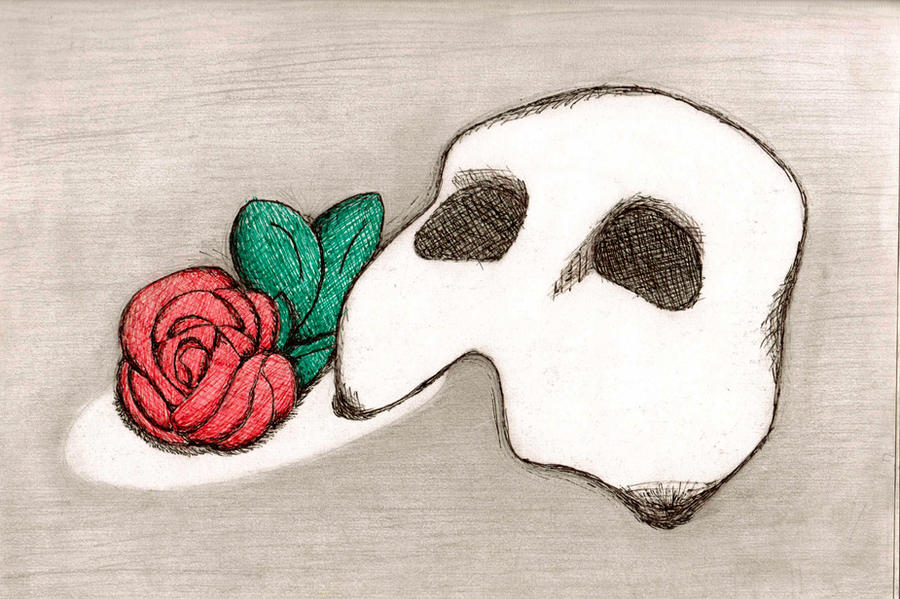
What music speaks to me.  Immediately, I knew. The musical I had attended at the Ahmanson Theater in Los Angeles. "The Phantom of the Opera."


Do not the lyrics make you grateful that you can experience the depth of emotion of the tormented hero of the story (I am no fan of Raoul).  However, it is the music that haunts and calls to you; leaving an imprint on your soul.
Phantom for the Opera by Andrew Lloyd Webber.
Music of the Night
Night time sharpens, heightens each sensation
Darkness stirs and wakes imagination
Silently the senses abandon their defenses
Helpless to resist the notes I write
For I compose the music of the night
[Verse 2: Phantom]
Slowly, gently night unfurls its splendor
Grasp it, sense it, tremulous and tender
Turn your face away from the garish light of day
Turn your thoughts away from cold unfeeling light
And listen to the music of the night
[Verse 3: Phantom]
Close your eyes and surrender to your darkest dreams
Purge your thoughts of the life you knew before
Close your eyes, let your spirit start to soar
And you live as you've never lived before
[Verse 4: Phantom]
Softly, deftly, music shall caress you
Hear it, feel it, secretly possess you
Open up your mind, let your fantasies unwind
In this darkness that you know you cannot fight
The darkness of the music of the night
[Verse 5: Phantom]
Let your mind start a journey to a strange new world
Leave all thoughts of the life you knew before
Let your soul take you where you long to be
Only then can you belong to me
[Verse 6: Phantom]
Floating, falling, sweet intoxication
Touch me, trust me, savor each sensation
Let the dream begin, let your darker side give in
To the power of the music that I write
The power of the music of the night
[Ending: Phantom]
You alone can make my song take flight
Help me make the music of the night
[Ending: Phantom]
You alone can make my song take flight
Help me make the music of the night

What music has touched your soul?  
If you are a novelist, what music speaks to you?

Happy Reading,

Connie


Wednesday, July 20, 2016

A Woman's Signature Fragrance--a Lasting Impression by Connie Vines

In my current anthology, Gumbo Ya Ya for women who like romance Cajun, one of my main characters is a perfumer.  Since I have past experience as a fragrance in an exclusive perfumery, I thought I’d share some helpful times when selecting a signature fragrance.

Perfume Terminology (or ABCs)

Absolutes

Pure, natural extracts and oils from flowers and other vegetable materials. Very expensive for a small amount. Example: pure rose oil.
tuberose from Morocco

Note

An odoriferous element in the perfume or cologne. When we smell a composed fragrance, we smell different notes within it. When the first scent — or top note — dissipates, we smell the middle note, also known as the bouquet. As that fades, we are left with the basic note, which is the third element of a composed fragrance. It’s like a symphony.

*test by spraying a small amount of fragrance on your forearm.  It takes 20 minutes before the alcohol evaporates and you smell the ‘true’ scent.

Secret Number One: Don’t commit to a scent until you smell the final note.

my fragrance testing kit

What exactly is Eau de Cologne?

Eau de Cologne is three to five percent oil in a mixture of alcohol and water. It tends to be lighter and refreshing, typically with a citrus oil component.

Eau de Toilette
Containing about the same amount of perfume oil or a little more — somewhere between four and eight percent — than Eau de Cologne, Eau de Toilette is mixed with alcohol instead of water.

Eau de Parfum
A higher percentage of perfume oil — roughly 15 to 18 — mixed with alcohol makes up Eau de Parfum. It is more expensive than Eau de Cologne and Eau de Toilette.

Perfume
Perfume is 15 to 30 percent perfume oil mixed with alcohol. Because it contains such a high percentage of perfume oil, it is far more expensive than Eau de Cologne, Eau de Toilette, or Eau de Parfum.

I Wear Eau de Parfum and Perfume.

Fragrance Families for Women
fragrance family chart

Fragrances are classified according to predominant scent characteristics. Four basic families make up most feminine fragrances. Floral/Sweet, Citrus/Fruity/Fresh, Oriental/Spicy, and Woody/Chypre. Within those families, there are sub-groups. Aromatic Fougère, a masculine scent family, used to be its own category, but was recategorized as a sub-category in the 2010 change. It has notes of lavender, fresh herbs, and moss.

At the perfumery I tested each client’s pH level and selected fragrances from each family for the pH level.  Without knowing your pH level you will need try several scents from each family to see what scent appeals to you.

Secret Number Two: Floral and Sweet for daytime, and perhaps an Oriental/Spicy scent for date night. In cooler weather, stronger scents can be worn without overwhelming everyone around you. Conversely, lighter scents are better in warmer weather. Think of how summer smells like fresh cut grass and scoops of vanilla ice cream. December smells like evergreens and gingerbread. You can evoke those same wonderful emotions and memories with your own aroma.

Citrus/Fruity/Fresh
Orange, lemon, lime, grapefruit, and other citrus fruits. Apricot, apple, peach, etc. Clean, light, and invigorating.

Oriental/Spicy
Warm vanilla, spices and incense resins. Reminiscent of the Far East. Also ambery and musky. Kind of mysterious!

Woody/Chypre
Scents like bergamot, oakmoss, labdanum, and patchouli. Mossy and very earthy smelling.

Choosing The Perfect Perfume
Perfumes and colognes are made up of many different accords to produce a harmonious scent. Because our body chemistry is unique to us, the same perfume will smell slightly different (or completely different) depending on who is wearing it.

Further, it will smell different in the bottle or sprayed on a card than it will on your skin.

Secret Number Three: Spray it on a card first. After five or ten minutes, smell it again. See if it still speaks to you. Then and only then, spray it on your skin. Remember with will take 20 minutes before the fragrance will be true to you pH level.

Secret Number Four: Never spray more than 4 fragrances at a time for testing.

Have you ever noticed how perfumeries have tiny jars of coffee beans scattered here and there? Take a sniff. It serves the same purpose as sorbet between dinner courses and cleanses your palate — or olfactory perception — in between scents.

How To Wear Your Perfume

Never spray on your wrists and then rub your wrists together, never tip the perfume bottle onto your skin because your body oil spoils the properties of the fragrance oils.

Apply the fragrance to the base of you skull because the warmth of your body and the movement of your hair creates release of the scent.  Or one spray of scent to your abdomen.  Do not spray on the front of you neck as even high priced Paris perfumes have properties that, over time, can create a slight discoloration on your skin. Remember, your fragrance will last all day.  There is no reason to spray the perfume into the air and walk beneath it.  If my room needs to be scented, I light a candle!

Enjoy your perfumes.  Purchase a small collector bottle or s sample before committing to a fragrance.

Signature fragrances chance as a woman matures.  I wear Chanel no 5.

What fragrance do you adore?


My signature fragrance


Coming Soon!


See you next week,
Connie


Wednesday, July 13, 2016

The Writing Process by Connie Vines

The Writing Process

I was tagged in a recent Blog Hop by a fellow board member of the
GothRom Chapter of Romance Writers, and I'd though I'd share the the topic: The Writing Process with everyone visiting "Dishin' It Out' today.

1. What am I working on right now?

I work on multiple projects at once.  Is this a good thing?  Probably not—but I do it anyway.  I’ve almost completed my novella, Bell, Book & Gargoyle (the 2nd in my Sassy & Fun  Fantasy Series)  while revising anthology: Gumbo Ya Ya (for who like romance Cajun). And I’m outlining Rand, Book 3 and Cochise, Book 4 in my Rodeo Romance Series.

2. How does my work differ from others in the genre?

I write in multiple genres and each of genres have a different “tone and focus”—in other words, a different ‘voice’.  My YA novel, Whisper upon the Water (Dream Award Winner, Nat’l Book Award nominee), is told in the 1st person.  The novel is complex; not only a coming-of-age but a transformation of society as a whole (Tay is Apache, Nde). My heroine begins as a girl on the verge of womanhood, a member of her band, speaking her native tongue. She is kidnapped, held hostage, and escapes. Taken to a Native American boarding school, she learns a new language, skills, and encounters prejudice but also kindness.  Later, she must make a very difficult choice.  Her decision will impact her life, as well as the lives of others.  The novel is written for YA level and is reading selection for the G.A.T.E. program in numerous SoCal schools, but the subject matter is not light, however, it is historical accurate.

In my Rodeo Romance Series: Lynx, Book 1, is a contemporary western romance and set in Montana and Texas. This book is lively.  Rachel is spirited and Lynx is hot and sexy—but both have had hardships in life.  My secondary characters add elements of comedy and unexpected plot twists. (Winner of the Award of Excellence, Finalist: H.O.L.T. Medallion, Orange Rose and Rocky Mt. Gold).  Brede, Book 2, is a western romantic suspense, set in New Mexico (99 cents this month on Amazon).  Since the novel is romantic suspense, I do not wish create a spoiler in this blog.  I will say everyone one loves old Caldwell, the ornery old cook, and his cohorts.  Brede is strong-willed and caring; Amberlynn is beautiful and in mortal danger.  Rand, Book 3, is told in the 1st person: ChickLit meets the Wild West and goes Hollywood. Lights, Camera, and a boot-full of Action! I am having, fun, fun with this novel! While, once again, in Cochise, Book 4, I draw upon my personal background and experiences--every wonder what goes on in planning a Pow-wow?  This novel will also address social issues.

My stories are different, because I am different.  My stories take place in places I have lived, or where I have vacationed. I know my subject matter--my father rodeoed while in high school; I have been involved in Native America culture and education programs; my husband is a Louisiana country boy; and, finally, I live in SoCal—of course I have met several Hollywood television stars (and facilitated workshops), actors are often spotted at local SoCal tourist spots, and preform in local theater.

3. Why do I write what I do?

The story calls to me, it is really that simple.  I have a feeling of time and place.  Then I begin hearing snatches of dialogue (like when you are sitting in a coffee shop and you over hear snippets of conversation).  The story invades my life (well it does, just ask my husband).  At the moment, I’m listening to Zydeco music and I have gumbo in my crockpot.  He’s complaining (only half kiddingly) that I brought bayou weather to our house (92 degrees, 50% humidity with full cloud cover and rain at 3 PM).  I am compelled to complete the story.  Native American culture says, “The story comes to the Story Teller to bring it to life.”  And this is what I, as are all writers, tellers of stories.

The French Quarter, New Orleans
4. How does my writing process work?

For short stories, novellas and anthologies, I utilize the basic W-plot with extra twists and pivotal points.  When I am writing a novel, or a novel series, I plot in acts and work with three chapters at a time (1-3, 4-6, etc.).  With the exception of short stories, I compile detailed backgrounds, motivation, and personality traits. I also conduct interviews, research, and immerse myself in the ‘culture/environment I am creating.  It is then I begin the first draft of my novel.  This will change as my characters begin to take over the book.  Any writer will agree with me, under no circumstances can you force you characters to act against his/her will.  You can, however, place huge obstacles in the way and see what happens.

Hollywood, CA


Is my first draft perfect? No.  Is my third draft publishable? It’s probably close.  At this point in the writing process, I have writer friend (usually Geeta Kakade) read my novel. She will give her opinion and suggestions—which I may, or may not follow.  Writing, after all, is subjective—as is a reader’s preference for one novel over another.


Coming Soon


To read the first chapter teasers or to purchase one (or all ) of my novels please follow this link:

http://www.amazon.com/Connie-Vines/e/B004C7W6PE


Remember to watch my book trailers!

Thank you for stopping by.

Connie Vines

Romance Reviews

The Romance Reviews