Showing posts with label rodeo. Show all posts

Friday, September 30, 2016

Native American Traditions--Powwows by Connie Vines

Today, I thought I'd blog about another Western tradition: Powwows.


Attending your first Powwow?

 The powwow as it is presently known is an inter-tribal event, dating from the 1880s, and while it owes much to pre-contact traditions, it responds to a fundamental binary view of Native populations in conflict with European culture.

 The name is derived from an Algonquian word, pau wau (“he dreams”) linked to “medicine” and “healing,” both in the broadest sense. While similar gatherings certainly occurred before European contact, once Native Americans were consigned to reservations, the need to create broader connections asserted itself.

 In big cities, the event may be held in a civic auditorium or park, but the more traditional venue is a brush arbor.

There is a saying among those of us who are Powwow  regular  attendees, "The Powwow doesn't begin until the dancers arrive." 

Since the dancers often travel long distances, starting time is only an approximate time.  Set-up you folding chairs or spread your blanket on the grass and relax.  Locate Fry bread booth--a must try tasty treat .  (Having operated many a Fry bread booth as a fundraiser, I can attest to the hard work required make pow wow successful)

What to expect:

During the Grand Entry, everyone is asked to stand as the flags are brought into the arena. The flags carried generally include the U.S. Flag, Tribal Flags, the POW Flag, and Eagle Staffs of various Native Nations present. These are usually carried by veterans.

Powwow Etiquette: 10 Rules to Follow in and Out of the Arena

Whether you’re a novice or veteran attending a powwow, certain behaviors are expected while you’re on the grounds or in the arena. Although customs may vary from tribe to tribe—and even from year to year—some basic rules remain the same.

Some breaches of etiquette are simply considered disrespectful while others may result in the offender being removed from the arena. Here are some tips to make sure your behavior is appropriate and your visit is memorable.

Dress modestly.

It is not appropriate to wear hats, swimsuits, extremely short skirts or shorts or halter tops. Do not wear T-shirts or other items of clothing with profanity or inappropriate slogans.

If you plan to participate in dances that are open to the public, keep in mind that some tribes require women to wear a shawl or cover their shoulders.

Always listen to the master of ceremonies or announcer

The MC will tell you when you can photograph and he will tell you when you can dance, Usually, visitors or outsiders can dance during the inter-tribal dance, but you need to listen for an announcement before you participate.

Stand up during the grand entry

Unless you are physically unable to stand, you are expected to show respect for the dancers and rise. The seats nearest the dancing circle are reserved for singers, dancers and drummers (If you’re a spectator, do not sit here.)

Powwow grounds should be considered sacred places

A blessing is performed ahead of time and your actions should show respect for this religious and sacred ceremony.

It’s like going to a church, If you’re going to a powwow, you need to honor where the dances came from, the traditions and story behind them.

The blessing that takes place beforehand sets the tone of the event,  Although the blessing is usually not open to the public, its spiritual nature should be taken seriously.

Do not bring alcohol, drugs or firearms to a powwow

An exception is tobacco used for blessings or as gifts. Smoking is considered disrespectful,

Follow protocol and common sense when it comes to taking photographs

Never shoot photos during prayers, gourd dances or flag songs, or when the Master of Ceremonies has prohibited it. Additional rules apply in specific circumstances. For example, spectators should not take photos of dancers in regalia without first asking permission.

This is especially true for professional photographers standing in the arena, Often dancers are wearing something special or personally spiritual to them. Some dancers don’t like their bead-work photographed because someone can see that and copy the design.

Never shoot photos of a dancer being initiated or receiving a plume or feather. Doing so can disrupt the spiritual process,

Powwows are colorful and high-energy events

Spectators should have fun but also keep in mind that participants are not simply entertainers. Especially during contest powwows, dancers, singers and drummers may be performing for money.

There are individuals who do this as a way of life, They take it seriously because it’s their income.”

Finally, be flexible

The most important rule is to be willing to change your expectations and adapt to new situation

You may be invited to participate in the dancing. Particularly if the invitation comes from an elder, it is not respectful to decline.  

 “Oh, no, I don’t know how” is not an appropriate response. Guaranteed: no one will ever laugh at you, but they might be hurt if you refuse hospitality. It’s easy. Observe others and do likewise. Relax. We will teach you the steps!


Powwow Jingle Dance


Crow Fair 


Fry bread -top with powdered sugar or honey


Excerpt from my YA novel, "Whisper upon the Water"

1880, Apacheria, Season of Ripened Berries

Isolated bands of colored clay on white limestone remained where the sagebrush was stripped from Mother Earth by sudden storms and surface waters.  Desolate.  Bleak. A land made of barren rocks and twisted paths that reached out into the silence.

A world of hunger and hardship. This is my world. I am Tanayia.  I was born thirteen winter ago. My people and I call ourselves "Nde" this means "The People". The white men call us Apache.


Whisper upon the Water --book trailers


Happy Reading!

Connie

Please visit everyone participating in today's Sunday Blog Hop:


Connie (yes me!), age 16, loving to dance


Wednesday, August 24, 2016

Mail-Order Brides in the Wild West By Connie Vines

MAIL-ORDER BRIDES in  the Wild West.

We have all watched many a western movie featuring Mail-Order Brides. I also recall a musical
 (Seven Brides for Seven Brothers) on stage before becoming a 1950's movie also.

So how historically accurate were these movies and (Here Come The Brides) television shows?

What was I able to uncover during my research?

The term "mail-order bride," as it applies to a marriage arranged via correspondence between American men and women in the Great Plains in the nineteenth century, is largely a misnomer. Twentieth-century folklore has it that a homesteader could peruse the Sears and Roebuck or Montgomery Ward catalogs and order a wife to be delivered to his dusty doorstep just as easily as he could order a rifle, stove, or stomach cure, but the truth is far more interesting.

 Arranged long-distance marriage existed in the Plains in a range of communities, took a number of forms, and grew out of a variety of social, economic, and cultural phenomena, but never involved the literal sale, purchase, or ownership of women, as the term "mail-order bride" suggests. (Thank goodness!)

Among Plains Indians, sight-unseen marriage was frequently arranged with the help of a middleman and could involve the payment of a "bride price," intended to compensate the woman's family for the impending loss of her labor. But intercultural marriage was rare. In 1854, at a peace conference at Fort Laramie, a prominent Cheyenne chief requested of the U.S. Army the gift of 100 white women as brides, but the army refused. Russian immigrants brought with them the tradition of koopla, whereby marriage brokers were paid a fee to pair men with potential spouses from the Old Country.

 During the peak years of overland migration, hundreds of thousands of white women traveled west, but the majority were already married, and it was thought that "suitable" single women did not go west alone. While many cowboys eschewed marriage for perpetual bachelorhood, homesteaders believed that married men made better farmers.

From the 1830s until the turn of the twentieth century, settlers pined for "that useful and essential article of household furniture–a wife." So severe was the shortage of single white women of marriageable age in Nebraska, recounts Mari Sandoz in Old Jules (1935), her classic portrait of Plains homesteading, "a man had to marry anything that got off the train."

By 1865 it was estimated that there were as many as 30,000 single women back east, a number augmented by the Civil War widows. The plenitude of bachelors in the Plains–and hence the chance for greater social and economic freedom away from home–beckoned women. Newspapers from Nebraska to Kansas and Wyoming (a state the Ladies Home Journal in 1899 declared a heaven for spinsters and widows) began to serve as forums for matchmaking, running regular "matrimonial columns" of paid advertisements, frequently with accompanying photographs, for example: "A young lady residing in one of the small towns in Central New York is desirous of opening a correspondence with some young man in the West, with a view to a matrimonial engagement. . . . she is about 24 years of age, possesses a good moral character . . . is tolerably well-educated, and thoroughly versed in the mysteries of housekeeping"; or more commonly, "A Bachelor of 40, good appearance and substantial means, wants a wife. She must be under 30, amiable, and musical." Across the Plains there arose a cottage industry of "heart and hand" catalogs, folded double sheets and broadsides devoted entirely to the matrimonial prospects.

Letters were the only means of courtship between potential mates separated by thousands of miles. According to one bride, the Pony Express "took about four weeks to go from east to west," and letters "often came in bundles." Language was a means of persuasion. Illiterate men could dictate their letters to typists who, for a fee, would doctor their sentiments on Remington Standards. Dishonesty was a risk. Men and women could easily misrepresent their physical attributes, their station, or finances. A homesteader who sent his betrothed a train ticket might find that she had turned it in for cash. A 1911 Wahpeton Times article tells of a New York girl for whom, upon arrival in Buford, North Dakota, "the spell was immediately broken" when she saw the face of her intended. ((Not unlike the social media matches of today's cyber world of romance.)


The railroad also played an important role in the western diaspora of single women. In 1882 businessman Fred Harvey sought young rural women "of good character, attractive and intelligent" as waitresses in whistlestop cafés along the Santa Fe rail line. Harvey required that they remain single for a year, live in chaperoned dormitories, and entertain callers in "courting parlors." By the turn of the century, he had married off nearly 5,000 so-called Harvey Girls.

In the 1870s, 80s and 90’S, Matrimonial News, a San Francisco based matchmaking newspaper helped to make love connections between the single men of the West and the statistically disadvantaged, single women back East. For $1.50 a word, people could place classified ads describing themselves and what they wanted in a potential mate. The paper’s goal was to “promote honorable matrimonial engagements and true conjugal felicities for amiable men and women.” If a match resulted in a wedding, both parties were required to pay an additional fee to the newspaper.


Most ads were fairly direct. I haven’t seen a single ad that mentioned enjoying long walks on the beach, but plenty of them were quite open about wanting someone who wasn’t ugly and had a specified amount of money. (At $1.50 a word, it’s a wonder that some ads didn’t read, “Me want woman!”) Interested parties would correspond with each other and often not meet until they were about to head to the altar. It was quite the leap of faith.


I have a feeling "Seven Brides for Seven Brothers" was not historically accurate--though a great deal of fun!

What would drive a woman to accept such a proposal?  What recourse did she have if she changed her mind?

If you have any 'family stores', please share in the comments section of this blog.

Happy Reading,
Connie

Link to Amazon.com !


For additional information:
Luchetti, Cathy. "I Do!": Courtship, Love, and Marriage on the American Frontier: A Glimpse at America's Romantic Past through Photographs, Diaries, and Journals, 1715–1915. New York: Crown Trade Paperbacks, 1996.
Riley, Glenda. Building and Breaking Families in the American West. Albuquerque: University of New Mexico Press, 1996.

Wednesday, August 17, 2016

Cowboy Lingo by Connie Vines

When it comes to vocabulary, you could say the cowboy tends to have a rather colorful one. However, I've listed a few words he has retired (or perhaps never used much in the first place).
1. Lasso:
This is a word that was used in the early days of cattle ranching, but fell out of favor fairly early on. Unlike many cowboy words that originated from Spanish descent, this one came from the Portuguese word, “laco,” meaning “to snare.” With the exception of a few California stockmen who continued to use it, the word “lasso” was replaced with “rope” within a few short years of its introduction around the late 1800s to early 1900s. This fact makes the popularity of “lasso” among city slickers, especially journalists, in this day and age even more baffling. Bottom line, a rope is a rope. Acceptable variations include “lariat,” “lass rope” and “twine,” but never “lasso.”
2. Bucking Bronco: 
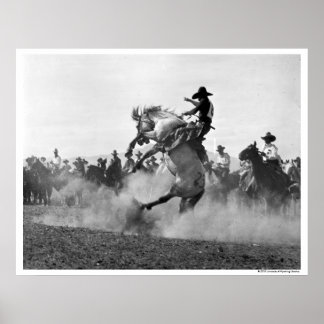
Another word that originated in the late 1800’s was “bronco,” derived from the Spanish word “potro bronco” meaning “untamed colt.” The “o” was quickly dropped and “bronc” is the word still used today. If you go to a rodeo, you will see two “bronc” riding events, bareback bronc riding and saddle bronc riding. However, if you hear just “bronc riding,” this is normally a reference to “saddle bronc riding,” whereas bareback bronc riding is simply known as “bareback riding.” Likewise, saddle bronc riders are referred to as “bronc riders” and bareback riders are known as such.  Just forget “bucking,”drop the “o” from bronco.


3. Chaps: 
This one is a little confusing. Most cowboy newbies pronounce the word “ch-aps” like “chapstick.” This is improper pronunciation of the word. It is actually pronounced “sh-aps.” As in, “Chantilly”.  And the short, knee or shin length chaps cowboys wear? Well, those are called “chinks,” pronounced exactly like you think it would be. 
4. Cowboy Up: 
Cowboys aren’t really much for following the crowd. If they were, they would be far less mysterious and cool. So, you may still hear this phrase tossed around occasionally, but likely more as a catchy story headline than a jolt of encouragement behind the bucking chutes.


5. Giddy-Up:
I looked this up in Webster’s online dictionary and it is actually a word, spelled giddyap. Meaning: to go ahead or go faster. Now, I have been around cowboys my whole entire life and I have never (not once) heard a cowboy say “giddy-up.” Although I am not sure what the precise origin of the word is, I have heard speculation that it may come from the draft horse driving command “gee up,” which means “go faster.” The only person I recall ever using is a parent sitting a toddler on a rocking horse.
For more cowboy speak, catch Pro-Rodeo interviews on ESPN.
Or, download one of my Rodeo Romance novels!
Click to link to Amazon.com!


Wednesday, June 22, 2016

Why We Like Cowboys. by Connie Vines

This is a re-post from March--because, you guessed it, I like cowboys :-)


Who hasn't thought about the cowboys of yesteryear driving cattle across the prairie, a lawman riding for justice, a modern day rodeo cowboy, or the rancher down the road?

What woman hasn't sighed?

There is something about a man in western boots, denim, and a Stetson cowboy hat that makes a woman's heart rate jump and her mouth go dry.

Is it their manners, chivalry, sense of justice, or the fact they take off their hats and say, "Thank you, Ma'am?"  All I know-- Cowboys have the "it" factor for me and many other women.

The swagger of a rodeo cowboy, the set jaw and stance of a lawman, the easy way the rancher leans over the corral fence. . .sigh.  There is something about cowboys


I write about cowboys in both the past and now.  I try to capture the raw maleness that seems to seep from their pours.  These are men who defend a woman honor or protect a child.  Men who will fight barehanded.    They respect women.  I believe it is because in days of the old West, women were few and far between.  Men were happy to have a female to cater to, and wanted them to hang around.


The saying goes:  A cowboy's hands are as strong as steel, as tough as leather, but soft enough to touch a humming bird's wing or the skin of a woman---and not disturbing the beauty of either.

Happy Thursday,

Connie Vines


Romance Reviews

The Romance Reviews